Writing and Spelling
✍️ What Does Writing Look Like at St Michael & All Angels
At St Michael's, we believe that writing is a powerful tool for communication, creativity and self-expression. We want every child to see themselves as a writer, developing the confidence, skills and imagination needed to communicate their ideas clearly and effectively.
Our writing curriculum is carefully designed to inspire children through high-quality texts, rich vocabulary and meaningful experiences. While reading sits at the heart of our English vision, writing is where children transform their knowledge, creativity and curiosity into their own authentic voice. From Early Years through to Year 6, we nurture curious minds and resilient learners, encouraging every child to write with purpose, accuracy and pride.
We use a bespoke, text-based approach to writing, developed by our staff and carefully structured to meet the needs of our children. High-quality texts provide the inspiration for learning, exposing pupils to ambitious vocabulary, effective language choices and a wide range of writing styles. Through engaging sequences of learning, children develop the skills needed to plan, draft, edit and publish their work, producing writing that is both purposeful and meaningful.
Our curriculum provides opportunities to write across a broad range of genres, including fiction, non-fiction and poetry. Children learn how to adapt their writing for different audiences and purposes whilst applying grammar, punctuation and spelling skills in context. Alongside this, a strong focus on transcription, handwriting and spelling ensures children develop the technical accuracy needed to become successful writers.
We have high expectations for all pupils and encourage children to take pride in their work, celebrate their achievements and develop resilience throughout the writing process. By the time they leave St Michael's, our children are confident communicators who can express themselves effectively, think creatively and use the power of writing to make their voice heard.
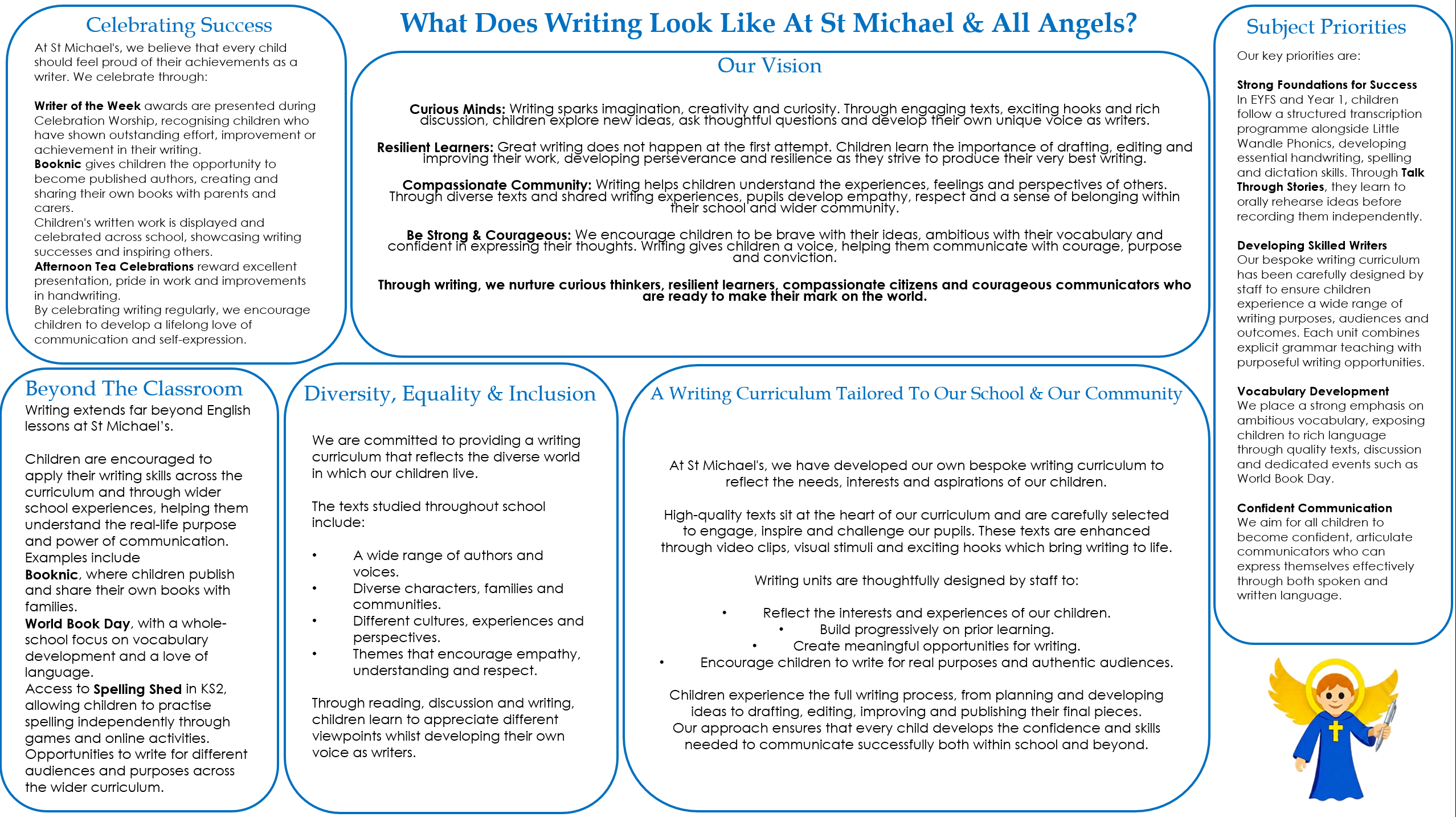
✨ Below, you can explore our Writing in a Nutshell overview, which provides a snapshot of how writing is taught across St Michael & All Angels and the journey our children take to become confident, capable and enthusiastic writers.
✏️ Spelling
At St Michael & All Angels, we know that confident spelling is a key building block for successful writing. Our approach is systematic, progressive and designed to help every child become an accurate, independent speller.
📚 A Clear Spelling Journey
From Year 2 to Year 6, children take part in regular, focused spelling lessons that build securely on prior learning.
- Year 2 follow the Little Wandle Bridge to Spelling programme, providing a seamless transition from Little Wandle Phonics.
- Years 3-6 use Spelling Shed, an engaging programme that combines explicit teaching with interactive games and practice activities.
🧠 Learning to Understand Words
We believe spelling is about much more than memorising word lists. Children are taught to:
Recognise spelling patterns and rules.
Explore how words are structured.
Apply spelling knowledge across a wide range of vocabulary.
Develop curiosity about language and word origins.
Become confident in selecting and checking spellings independently.
This approach helps children become flexible, resilient writers who can confidently apply their knowledge in new contexts.
🔤 Common Exception & High-Frequency Words
Alongside spelling patterns and rules, children regularly practise common exception words and high-frequency vocabulary. Securing these words improves fluency, accuracy and confidence, allowing children to focus on the content and quality of their writing.
🏠 Supporting Spelling at Home
We value strong partnerships with families and encourage regular practice beyond the classroom.
Through Spelling Shed, children can access:
Weekly spelling lists
Common exception and high-frequency words
Interactive games and activities linked to classroom learning
By working together, we help children develop the knowledge, confidence and enthusiasm needed to become successful spellers and writers.
📄 Further Information & Useful Documents
- English Glossary
- National Curriculum - Spelling
- Year 3 spelling overview
- Year 4 spelling overview
- Year 5 spelling overview
- Year 6 spelling overview
- Common exception words y1 - 6
-
Spelling Shed This website is used by children from Y3 to Y6 for home learning to further consolidate spellings that have been learnt in class that week.